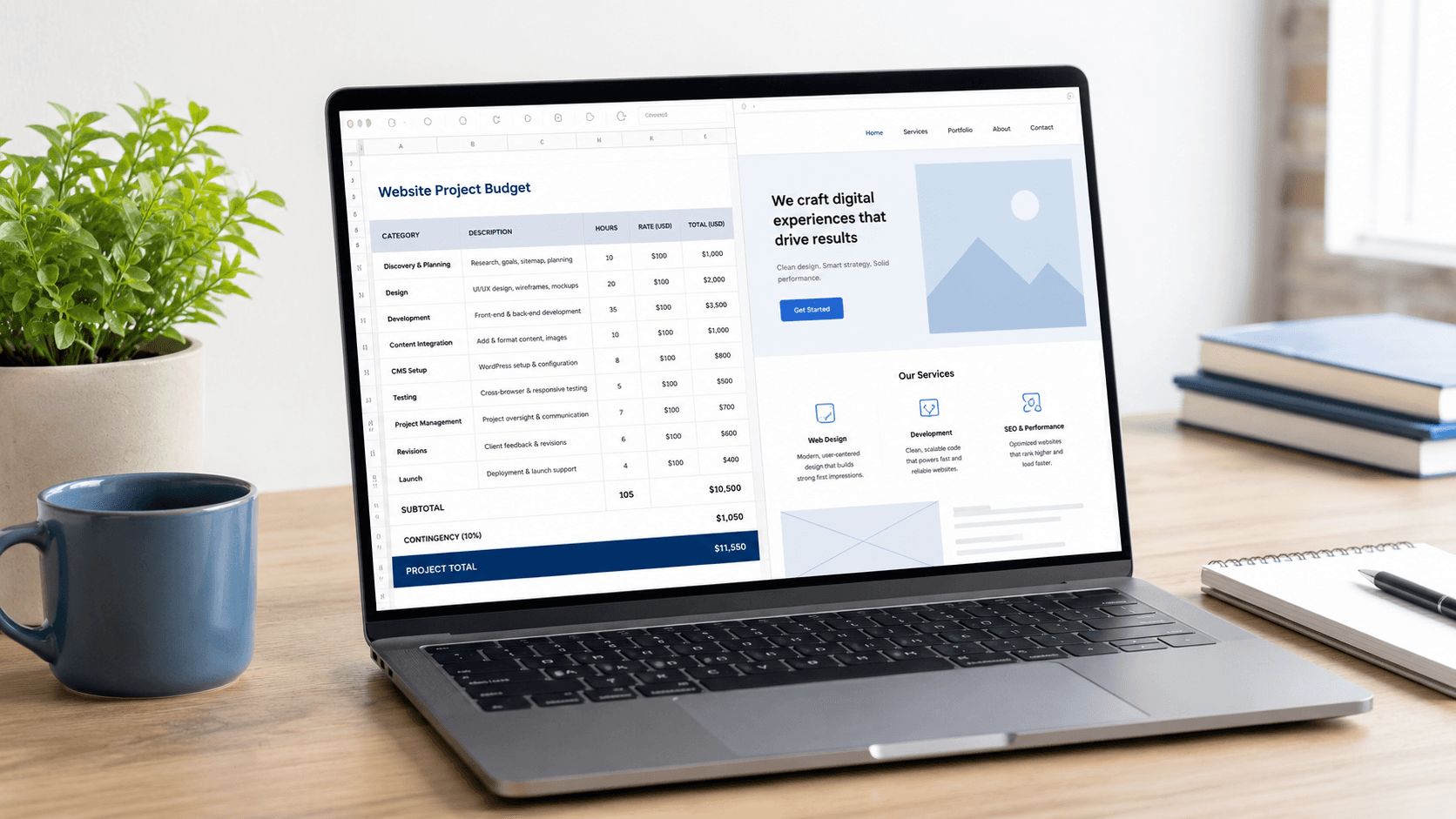
Ask ten people "how much should a website cost?" and you'll get ten different numbers, most of them wrong for your situation. Not because anyone's lying — because the question itself is incomplete. A website's price isn't really about the website. It's about what the website has to do for your business, and almost nobody figures that out before they start asking for quotes.
Here's a more useful way to think about it.
Start with the job, not the price
A five-page site that tells people who you are and how to call you is a different project from a site that needs to take payments, manage inventory, or book appointments automatically. Before you ask "how much," ask: what does this site actually need to do on day one? Everything downstream — the price, the timeline, the platform — follows from that answer.
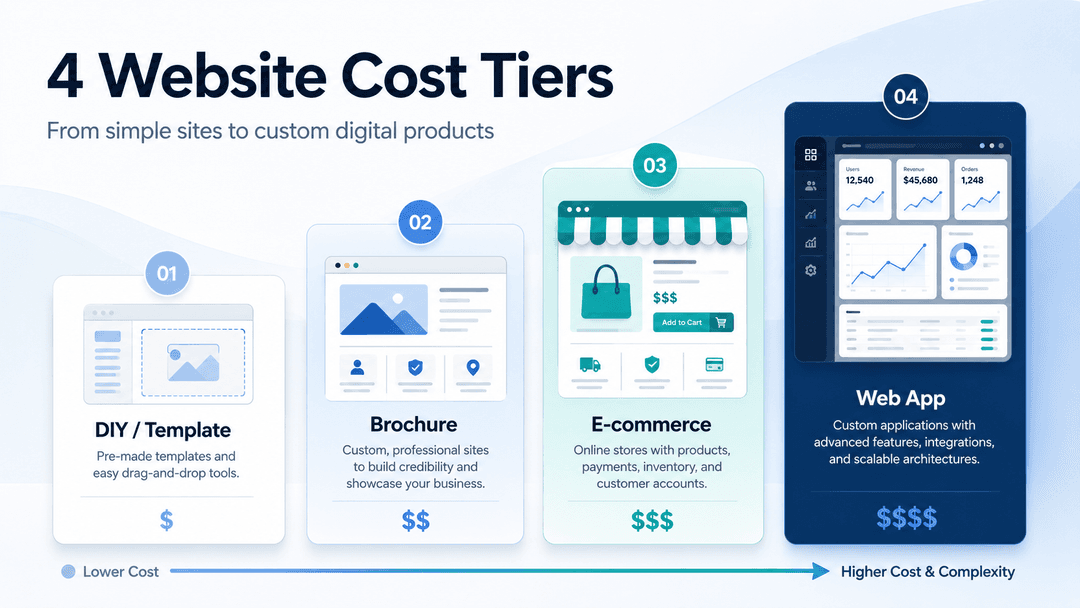
Rough cost bands (and why they're rough)
These are general market patterns, not a quote — treat them as a way to sanity-check what you're being offered, not a number to hold anyone to.
DIY / template builders (Wix, Squarespace, an off-the-shelf WordPress theme): cheapest option, and fine for a very early-stage business that just needs to exist online. The tradeoff is limits — on design, on performance, on what happens when you outgrow the template.
Small custom brochure site (roughly 5–10 pages, real design work, built on something like WordPress): the most common serious option for an established small or mid-sized business. You're paying for a site that looks and loads like it belongs to a real company, not a template.
E-commerce site: everything from the brochure tier, plus product catalog management, checkout, payment gateway integration, and usually ongoing work as the catalog changes. This is where "just build me a website" quietly turns into a bigger project than people expect.
Web application / custom software: the top of the range — think customer portals, booking systems, anything with real logic behind it, not just pages. Pricing here is closer to software development than website design, because that's what it actually is.
The costs nobody budgets for
The build price is rarely the whole story. Before you commit to a number, account for:
Hosting and domain renewal — small, recurring, easy to forget until the bill surprises you a year in.
Maintenance — plugin and core updates, security patches. Skip this and a WordPress site in particular becomes a liability, not an asset.
Content — someone has to write the copy and take or source the photos. That's either your time or a separate line item.
The "one more thing" tax — almost every project grows by 10–20% once you actually see it built and realize what's missing. Ask your agency how they handle scope changes before you sign anything. (For a realistic sense of how long each stage actually takes once you factor this in, see our website redesign timeline guide.)
Why fixed scope beats an hourly clock for most small businesses
An hourly rate sounds fair until you're the one checking the meter every time you ask a question. For a business that needs to know what it's spending, a fixed scope and a fixed price — agreed after a proper discovery conversation, not guessed at from a form — is almost always the better deal, even if the headline number looks higher than a cheap hourly quote. You're not just buying a website; you're buying the ability to budget for it. You can see what fixed-scope projects actually look like in our work.
Three questions to ask before you request quotes
What does this site need to do in the first six months — not eventually, first six months?
Who's going to update it after launch, and how technical are they?
What happens if the scope grows halfway through? Get this answered in writing before you start.
Answer those three honestly and most agencies' quotes will suddenly make a lot more sense — or reveal themselves as either underscoped or padded.
If you'd rather skip the range and get one real number for your specific situation, request a quote — we scope it in a short discovery call and come back with a fixed price, not an hourly clock.